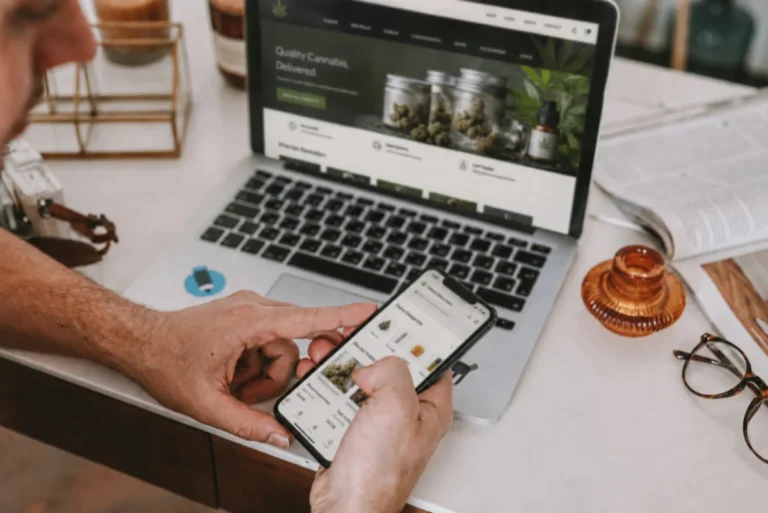

Most dispensaries treat cannabis ecommerce as a purchasing decision. Pick Dutchie, Jane, or Treez, embed the menu, watch the orders come in. The menu becomes the busiest page on the site, and everybody assumes it’s the page bringing people in.
It usually isn’t. Across the dispensary sites we run week after week, the online menu page earns almost all of its search traffic from people who typed the dispensary’s name into Google. Those customers were already walking in. The menu converts them — it doesn’t find them.
That distinction decides where the next dollar goes. Operators who believe the menu is an acquisition page spend on the menu: more banners, more product tiles, another platform migration. Nothing moves, because the page was never in the acquisition business. A cannabis ecommerce setup that actually grows a dispensary is built the other way around — a transaction layer that does its one job cleanly, sitting inside a site that does the finding.
What does a cannabis ecommerce platform actually do for search?
Almost nothing, and that’s by design. A cannabis ecommerce platform is a transaction layer: it holds live inventory, runs the cart, applies compliance limits, and processes the order. It is not built to earn rankings, and the menu it renders usually can’t be optimized the way the rest of your site can, because the content lives in the platform, not in your website.
That’s a fair trade when you understand it. Inventory changes hourly and compliance rules change by state; you want a specialist handling that. The mistake is expecting the same system to also produce local search visibility, because the two jobs pull in opposite directions. A menu is built to be current. A ranking page is built to be stable, indexable, and about something specific enough for Google to file.
The practical consequence shows up the first time an operator searches for their own products and finds nothing — the strains and brands sitting in the menu are rendered by a platform rather than published as pages Google can read. That’s a specific, fixable diagnosis, and we’ve walked through what it looks like when a dispensary’s products are invisible on Google in full.
See how LeafSuite builds this into a weekly system for licensed dispensaries. → Digital Dispensary Foundation
Why does the menu page look like it’s ranking when it isn’t?
Because of how Google reports your own brand name. Search a dispensary by name and Google returns one result with a block of sitelinks underneath it — shop, specials, about, contact. Search Console logs an impression against every URL in that block, each at roughly position 2, even though only one result appeared.
We measured this on a client’s site and found nearly seven URLs recorded per single brand search. Seven pages each reporting a near-identical impression count at “position 2,” with the homepage taking almost every click. Those pages were not ranking second for anything. They were lines inside one result.
The menu page is the biggest beneficiary of this illusion, because it’s usually the first sitelink. Pull brand queries out of the report and the same page’s non-brand footprint collapses to a small fraction of what it appeared to be, and it holds across the dispensary sites we run, in different states, on different site builds.
Two things follow, and we act on both. We don’t point link building at the menu page, because a link can’t create demand that doesn’t exist. And we don’t judge a cannabis ecommerce setup by the menu’s traffic numbers, because those numbers are mostly the dispensary’s own name.
What does your checkout cost that the platform invoice doesn’t show?
This is the part operators rarely see coming. Online ordering flows routinely call paid third-party services mid-checkout — address validation, delivery-radius checks, mapping — and those calls bill to your own cloud account rather than to the platform.
We found exactly that with the dispensaries we run. The checkout’s delivery-eligibility step fires a paid geocoding call on every single online order. It’s a required part of the flow and can’t be switched off. For over a year it cost nothing, because it sat inside a free allowance. Then order volume crossed the threshold and a charge appeared on a bill nobody had been watching — not because anything changed on the operators’ side, and not because the platform did anything wrong.
The amount was small. The lesson isn’t. A cannabis ecommerce integration is a running dependency, not a one-time install, and part of it lives on infrastructure you own and are responsible for. Whoever builds your site should know which outside services your checkout calls, whose account they bill to, and what happens to that number when orders double.
How should a dispensary choose a cannabis ecommerce setup?
Judge the platform on the transaction, and judge everything else separately. Four questions settle most of it:
- Does the cart hold up under load and stay compliant in your state? That’s the platform’s actual job. Order limits, ID checks, purchase caps by product type.
- How many taps from landing to cart? Speed and depth are conversion, not decoration. A menu buried three taps deep loses people who were ready to buy.
- What customer data reaches infrastructure you own? Every opt-in, loyalty signup, and promo claim should end up somewhere you keep if you ever change platforms.
- What outside services does the checkout call, and whose account do they bill? Ask before you sign, not when the first invoice arrives.

Notice what isn’t on that list: which platform ranks better. None of them do. Choosing a cannabis ecommerce platform to improve search is like choosing a cash register to improve foot traffic.
Where the acquisition actually happens
Outside the menu, on pages you control. Location and category pages that Google can index and file. A site fast enough that visitors from search don’t bounce before the menu loads. Reviews and a Business Profile pulling in people who searched a product or a neighborhood instead of your name — that’s Local Demand Capture doing the finding, and it’s covered in more depth in what cannabis website design actually requires.
Then the menu earns its keep. It takes the customer that local search produced and turns them into an order, on a checkout that captures an opt-in you keep — which is what gives the Retention Engine something to work with next month. That’s the sequence the platforms can’t sell you, because each of them only owns one piece of it. We’ve made the same argument about why Dutchie, Jane, and Weedmaps can’t carry your whole strategy; cannabis ecommerce is where it gets expensive to ignore, because the menu is the page that looks the most like it’s working.
The dispensaries that grow don’t have better menus. They have a site that brings people to one.
Related proof: One dispensary we work with came in on a slow, menu-dependent site with online ordering buried three taps deep. After the Digital Dispensary Foundation build, their Google PageSpeed score moved from 55 to 92 — the site stopped being the reason customers dropped off before the cart.
Is Your Menu Doing a Job It Was Never Built For?
Most operators can’t tell until they separate brand searches from everything else. See where you stand.