
You have a marketing budget and almost nowhere legitimate to spend it.
Every channel a normal retailer reaches for first is closed to you. Google Ads won’t take your money. Meta won’t run your creative. Billboards are getting pulled market by market. So the budget goes where it can go — Weedmaps, Leafly, a boosted post that gets flagged, a promo that eats margin — and twelve months later there’s nothing to show for it. No asset. No list. No ranking. Just a spend history.
That’s the real cost, and it isn’t the money. It’s that every dollar bought attention you had to rent again the following month. The moment you stop paying, you’re invisible again.
Cannabis marketing SEO is the fix, and it isn’t a channel you add. It’s the anchor the rest of the Dispensary Momentum System is built around, because it’s the only major acquisition surface in this industry that compounds instead of resetting.
What is cannabis marketing SEO?
Cannabis marketing SEO is the practice of earning organic search visibility for a licensed dispensary — in Google’s local pack, in organic results, and increasingly in AI-generated answers — without paid advertising, which cannabis retailers are largely barred from. Because paid amplification isn’t available, search functions as the primary acquisition engine rather than one channel among many.
That last sentence is the whole strategic difference. For a pizza shop, SEO is a nice-to-have running alongside paid search. For a dispensary, it’s the acquisition engine, and everything else in the marketing plan either feeds it or is fed by it.
Why can’t dispensaries just buy their way in?
Because the largest ad platforms in the world have written you out of their policies, and they aren’t quietly negotiable.

Google’s Dangerous products or services policy is explicit: ads for substances that alter mental state for recreation or otherwise induce highs are not allowed. The single carve-out is topical, hemp-derived CBD at 0.3% THC or less — and even that requires an application and is limited to California, Colorado, and Puerto Rico. Nothing you sell over the counter qualifies. Meta’s commerce policies land in the same place.
This is not a gap waiting to close. Plan around it as a permanent condition, because operators who keep waiting for the platforms to change their minds spend years not building the thing that actually works.
See how LeafSuite builds this into a weekly system for licensed dispensaries. → Dispensary Local SEO
What does search actually anchor?
Search doesn’t work in isolation, and treating it as a standalone line item is the most common way dispensaries waste it. Rankings that land on a site nobody can order from are wasted. Traffic that arrives once and never returns is wasted. The three engines exist because search only pays off when something catches what it brings in.
Digital Dispensary Foundation is where search traffic lands. A site Google can crawl, a menu shoppers can actually order from, and analytics that show you what happened. Rankings need somewhere to arrive — what your dispensary website actually needs is a shorter list than most agencies pitch, but every item on it is load-bearing.
Local Demand Capture is search itself: the map pack, the “near me” queries, the brand-purchase searches, the reviews and listings that decide who appears when someone three miles away is deciding where to go. This is the layer competitors can’t buy their way onto, which is exactly why it’s worth owning.
Retention Engine is what stops the traffic from being a one-time visit. Search brings a stranger through the door once. Email and SMS built on a list you own is what brings them back the next eleven times, on a schedule, without discounting your way to it.
Pull search out and the other two starve. Pull the other two out and search becomes an expensive way to generate first visits that never repeat.
Where the budget usually goes wrong
Rented attention feels like marketing because it produces traffic. It just doesn’t produce an asset.
A Weedmaps placement stops the day the invoice does. A discount brings in customers priced on the discount. Neither leaves anything behind. The distinction worth applying to every line in your plan: at the end of twelve months, do you own more than you did at the start?
Search-anchored work answers yes. Rankings you earn stay earned. A subscriber list is yours. A site that indexes well keeps indexing well. That’s what compounding growth means in practice — not a bigger monthly number, but a base that doesn’t reset when you stop spending.
Dispensary SEO also isn’t the same discipline a generalist agency sells. Restricted platforms, compliance-shaped content, a citation ecosystem that runs through cannabis-native directories, and a menu that changes daily all make it fundamentally different from standard local SEO. Hiring for general local SEO and hoping it transfers is how operators lose a year.
How long does cannabis marketing SEO take to work?
Expect early movement in the first two to three months — indexation, map-pack position, impressions — and meaningful revenue impact over 12 to 18 months. Search compounds rather than switching on, so the curve is slow at the start and steepens as rankings, reviews, and owned-channel lists build on each other.
Here’s what that arc looked like in practice. When we took on Vallejo Relief Center, the site was a one-page placeholder with almost no search footprint — buried under competitors and directories for its own city’s terms. Over 17 months of weekly execution, VRC’s average map rank moved from 6.7 to 2.7, Google impressions went from 143K to 820K year over year, and the site went from that single page to more than 3,000 indexed pages. It now ranks #1 for 64 of 100 tracked local searches in its market.
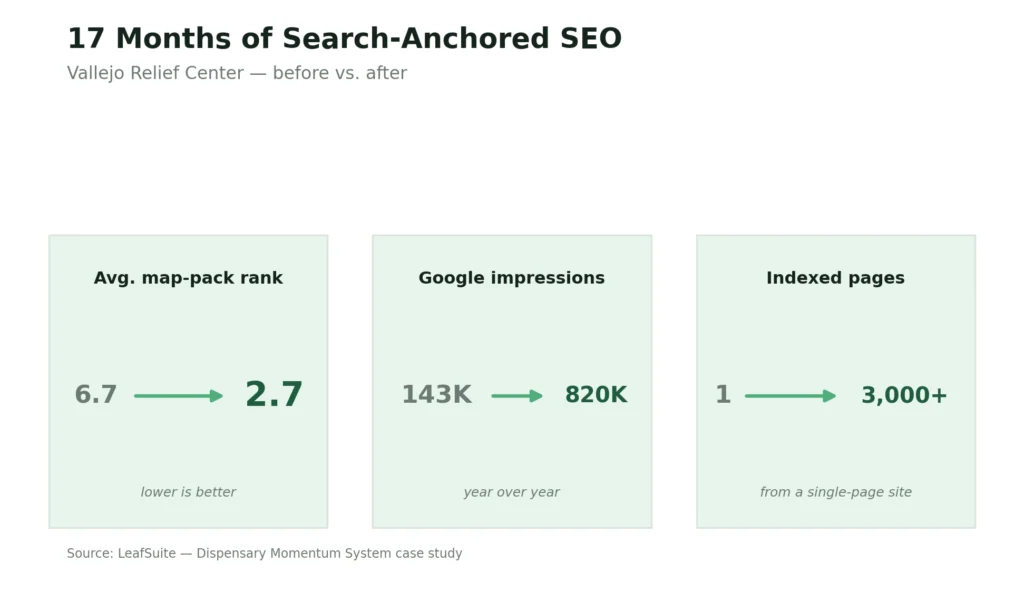
What that means: nothing in month three looked like a transformation. The compounding is the point, and it’s also why starting late is the expensive choice.
What does a search-anchored strategy look like week to week?
It looks unglamorous, which is the tell that it’s real.
Every week the same rhythm runs — pages tightened, rankings checked and defended, reviews requested and answered, listings kept accurate, one email and one SMS out to a segmented list, and the numbers reviewed to decide what gets adjusted next week. Nothing about any single week is dramatic. The compounding comes from the fact that it happens again seven days later, and that nothing resets between cycles.
That’s the difference between a marketing plan and a marketing system. A plan is a list of things you intend to do. A system is a cadence that keeps producing whether or not this was a busy month.
Tired of Renting Attention You Don’t Own?
Get your dispensary marketing audit and find out what’s actually earning rankings versus what’s costing you every month.
Related: VRC — 473% Google impression growth, #1 for 64 of 100 tracked local searches, and $11K+/month Springbig-attributed revenue in 17 months. Theo, NJ — 15 → 41 #1 keywords, impressions up 375% year over year, and $7K+/month Springbig-attributed revenue in 13 months, in one of the country’s most crowded markets.