A dispensary owner asked me to audit their site last month.
It was good. Genuinely. Clean design, branded photography, a blog updated every week, a menu wired right into the site. Better than most.
I almost sent back a two-line email: “You’re in great shape, keep going.”
Then I looked under the hood.
I recorded the full teardown on video — watch below, or keep reading for the breakdown.
Their products couldn’t be found in search. Not “ranking on page two.” Not “needs a nudge.” Invisible. Hundreds of products in stock, and Google didn’t know a single one of them existed.
That’s the most expensive mistake in cannabis dispensary local SEO — a site that looks finished but can’t be found. And it’s everywhere. In an industry where the state will fine you for a mislabeled gram but nobody flags the fact that Google can’t see your menu, this is the gap that quietly bleeds revenue.
Here’s what I found, what it was costing them, and how to check your own site in about two minutes.
A site can look done and be broken
Clean design. Weekly blog. A menu that loads. Traffic stats that look healthy.
None of that means you’re getting found.
Search engines don’t read your site the way a customer does. The second those two views split apart, you can look great to every human who lands on the page while quietly vanishing from the search results that bring new ones in.
That’s the trap. Everything looks fine, so nobody checks.
This is local SEO for dispensaries — and we run it as a weekly system we call Local Demand Capture, not a one-time fix.
The headings were working against them
Your H1 is the most important heading on the page. It tells Google, and now AI search what the page is about.
Theirs said the brand name. That’s it. No city. Nothing a real customer would ever type.
Then it got worse.
The page had eight H1 tags. It should have one.
Scroll the code and there’s “lorem ipsum” placeholder filler sitting in headings. The word “Redeem” repeated over and over in headings no visitor ever sees.
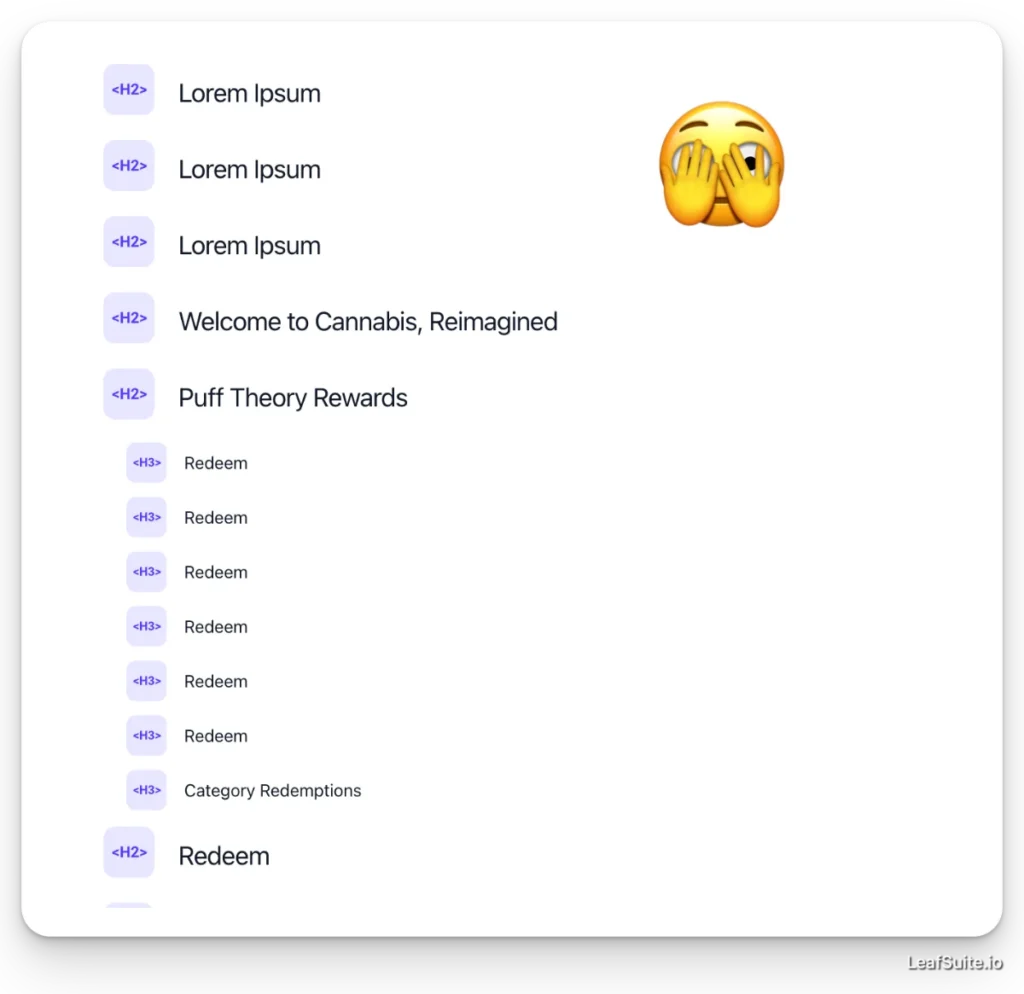
To a person, the page looked normal. To a search engine, it was noise.
30 of 32 images had no alt text
On its own? Minor.
As part of a pattern? Loud.
Every image is a small chance to reinforce what the page is about and where the dispensary actually operates. They’d skipped 30 of them. That’s the kind of thing that gets missed when nobody is looking at the site through a crawler’s eyes.
The big one: Google couldn’t see the menu
Here’s where it went from “fixable” to “fix this now.”
Their entire product catalog wasn’t being indexed.
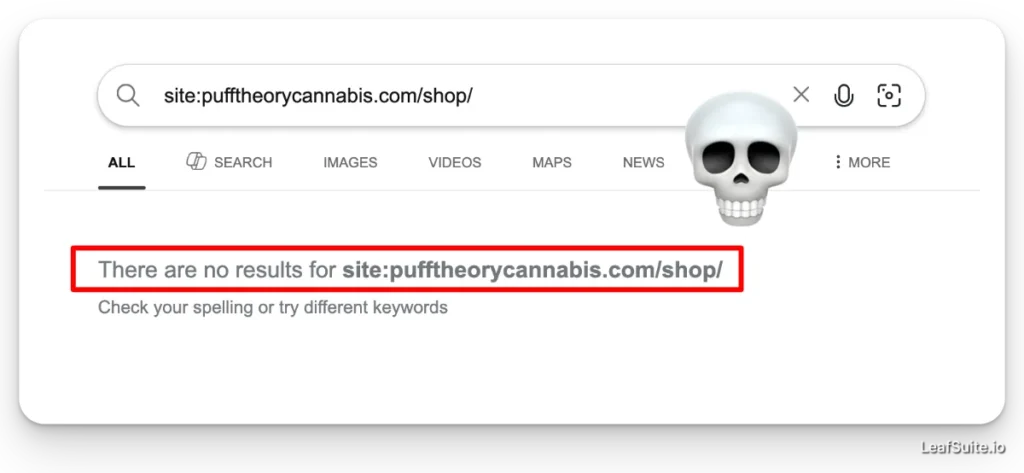
I searched Google for their shop pages. Out of hundreds of products, a handful showed up. I checked Bing. Zero. Not one.
The menu is loaded through JavaScript. Disable JavaScript in the browser and the whole menu disappears — gone, blank space. Search crawlers don’t reliably run that JavaScript. So to Google, those products simply did not exist.
Now think about what that costs.
Someone two miles away searches for a specific brand or strain near them. That’s the highest-intent search there is — wallet already out, ready to drive over.
This dispensary had the product on the shelf. And they didn’t show up.
So that customer bought it somewhere else. Every single day, the demand this dispensary already paid to create was walking to a competitor at the last step.
Why their SEO agency missed it
Here’s the part that should bother you: they already had an SEO agency.
And you could see the work in spots. Some schema in the code. A proper page title. Real effort.
But a generalist treats a dispensary like any other small business. Cannabis has its own landmines — menu platforms that render through JavaScript, compliance limits on what you can say and where, and the fragile way an online menu connects to the main site.
The one piece that needed cannabis-specific eyes was the exact piece that was broken.
I’ll say it plainly: a generalist agency should not be running dispensary SEO. Not because they’re bad at SEO, but because they don’t know where cannabis hides the bodies.
What strong cannabis dispensary local SEO requires — check yours in two minutes
Four things you can verify today. No tools, no agency.
First, your homepage. Is it actually maintained — current promos, events, real reasons to walk in? A build-once-and-forget homepage reads as stale to customers and search engines both.
Second, your headings. One H1 per page. It should name what you do and the area you serve — not just your logo.
Third, alt text on your images. Plain, relevant descriptions.
Now the one that matters most.
Go to Google. Type site: and then your shop URL. Like this: site:yourdispensary.com/shop
Hit enter.
You should see your products listed out. Lots of them.
If you see a handful, or nothing, you have the same problem this dispensary did. And it needs attention now, not next quarter.
Getting found is one engine of three
Making your dispensary the obvious answer when someone nearby searches is Local Demand Capture.
But it doesn’t work alone.
It sits on top of the Digital Dispensary Foundation — a website and menu built so search engines can actually read them. And it feeds the Retention Engine, where the customers local search brings in get turned into regulars through email, SMS, and loyalty.
Together that’s the Dispensary Momentum System. The whole point is the connection between them. Traffic you can’t capture is wasted. Customers you don’t bring back are only rented — which is why search has to anchor the whole strategy.
We run all three. Week after week.
Want a clearer growth plan for your dispensary?
Book a Dispensary Growth Audit. I’ll show you exactly what’s holding back your revenue — starting with whether Google can even see your products.
Proof it works: VRC went from 4 to 65 #1-ranked keywords in 17 months, alongside 473% growth in Google Search impressions. Read the full case study.

Dallion McGregor
Dallion is the founder of LeafSuite, a marketing agency built only for cannabis dispensaries. He’s helped independent shops go from invisible on Google to ranking #1. He lives in Oregon with his wife and children, serving an industry the banks pretend doesn’t exist.
Want to Know If Google Can Find Your Dispensary?
Find out exactly what Google sees and what it doesn’t. One audit reveals the exact gaps keeping your dispensary off local search results.