
Every dispensary owner gets the pitch from both, and sooner or later asks the question operators trade on Reddit: Leafly vs Weedmaps, which one actually earns its money? It’s the right question to ask. A marketplace listing is one of the biggest recurring lines in a dispensary’s marketing spend, and most shops can’t say what it returns.
The answer usually has less to do with the platform than with the math, and both get judged against the wrong benchmark. The listing doing the most work for most dispensaries is the one Google gives away.
Here’s what each platform actually sells, how to tell whether a listing pays for itself, and where both fit next to the channels you own.
What you’re actually buying from each
Both companies have published annual reports (Leafly’s latest covers 2024), so you don’t have to take a sales rep’s word for how they make money.
Leafly sells retailers a monthly subscription for a business listing: address, hours, menu and reviews in front of its audience. In its 2024 annual report, Leafly reported an average of 5.1 million monthly visitors and average revenue of $692 a month per retail account. It also ended the year with 15% fewer paying retail accounts, which it put down mainly to customer budget constraints and removing non-paying accounts.
Weedmaps sells a listing subscription too, but the bigger lever is placement. Its parent company’s 2025 annual report describes a fixed inventory of featured listing and display advertising in each market, priced through a competitive auction that reflects local demand. Its average paying client, retailers and brands together with software included, paid $2,805 a month in 2025. Weedmaps has also stopped reporting monthly active users as a key metric, a decision it made in 2022.
That auction is the detail to remember. On Weedmaps, the price of being seen is set by the shop down the street bidding for the same spot. When competition in your market heats up, your cost goes up with it, whether or not the platform sends you more customers.
See how LeafSuite builds this into a weekly system for licensed dispensaries. → Local Demand Capture
Leafly vs Weedmaps comes down to cost per new customer
Audience size and feature lists make for a good sales deck. The comparison that matters is what each platform costs per customer it brings in who wouldn’t have come anyway.
The arithmetic fits on a napkin. Say a listing and placement run $1,500 a month. Your average ticket is $50 and your gross margin is 45%, so each order earns about $22.50. The platform has to cause roughly 67 orders a month to break even.
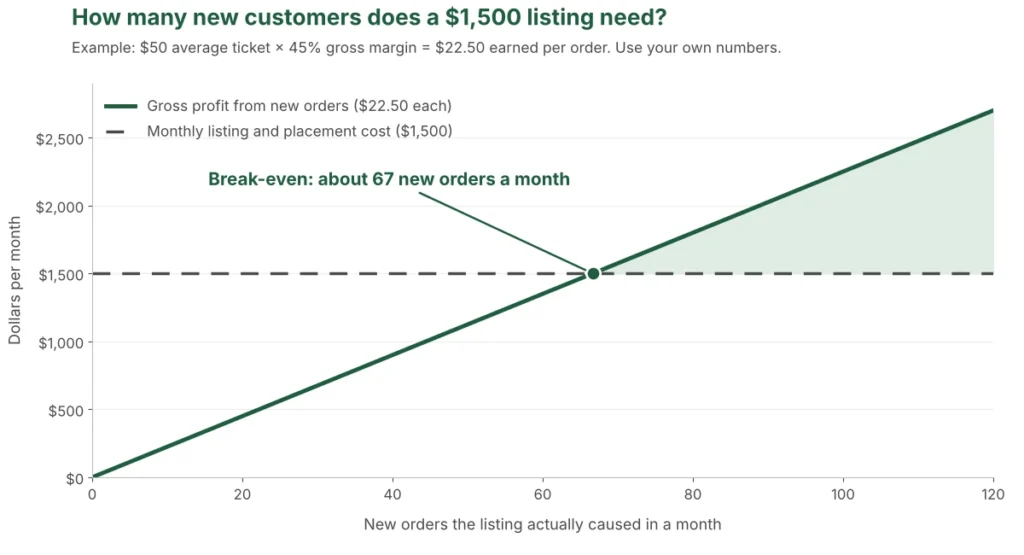
“Cause” is the word doing the work. A regular who opens Weedmaps to check your menu before driving over was already your customer. Counting that order as marketplace revenue flatters the listing, and it’s the most common way a listing looks better on the platform’s dashboard than it does in your bank account.
Three questions get you closer to the real number:
- How many platform orders last month came from customers who had never bought from you before?
- How many of those first-timers have come back since?
- What happens to both numbers if you drop the paid placement for a month and keep the listing itself?
The second question matters most. Headset’s research on the retention gap found that 67.1% of cannabis shoppers don’t return to the same store within six months of a first visit. A marketplace customer who never comes back cost you a full acquisition for one order. One who becomes a regular pays for the listing many times over. Which of those you get depends far more on what happens at your counter than on which app they came from.
The listing you don’t pay for often does more
Your Google Business Profile costs nothing, and it’s what appears in the map pack when someone nearby searches for a dispensary. Most of the work of winning the local pack happens there, on a page you control.
Your own website can compete with the marketplaces directly, too. This summer, one dispensary we work with held the top organic result for “cannabis deals” in its city with its own specials page. It sat above Weedmaps’ page for the same search, with the shop’s live offers pulled straight into the result. That’s exactly the search a deals-driven marketplace exists to win, and the shop’s own page won it.
That doesn’t happen by accident. Cannabis businesses play by different rules on Google, which we covered in why dispensary SEO is different from standard local SEO. But it’s earned position, not rented position. It doesn’t reset when a competitor outbids you, and it doesn’t disappear when you cancel a subscription.
Your marketplace pages still feed Google
Paying less for a marketplace doesn’t mean ignoring it. A listing does two jobs outside the app.
First, it shows up in Google. On a plain “weed dispensary” search in one shop’s city this fall, the Weedmaps result sitting next to the shop’s own listing showed its star rating. Shoppers comparing options read that rating whether or not they ever open the app.
Second, it’s a link. For one dispensary we work with, its Weedmaps listing is the highest-authority website linking to it.
So keep every listing accurate. The name, address, phone number and hours should match your Google Business Profile exactly. Send most review requests to Google, since that’s what feeds the map pack, but let a share land on the marketplaces, because shoppers read reviews there too. And if you cancel a paid plan, ask your rep exactly what stays live, then make sure whatever stays is correct. A listing with last year’s hours does more damage than no listing.
Get marketplace customers onto a list you own
A customer who found you on Leafly or Weedmaps is still the platform’s audience. Next time they want something, they’ll open the same app and see the same competitors next to you.
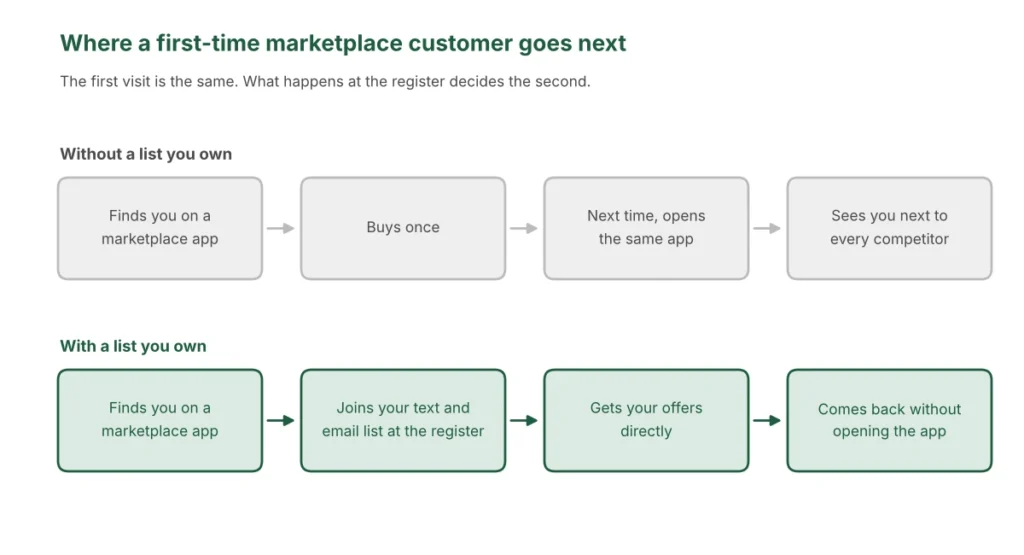
The fix is at the register. Every first-timer, however they found you, should get a reason to join your text and email list before they leave. Once they’re on it, the next visit doesn’t depend on who bought placement that week. We covered what makes that list worth staying on in dispensary loyalty program best practices, and why your menu belongs on a site you own in Dutchie, Jane and Weedmaps shouldn’t be your whole website strategy.
So which one should you pay for?
Pay for the one that passes the break-even test in your market, and only at the placement level that passes it. If you can’t tell, run the test before you renew. If neither passes, keep the listings accurate, stop paying for placement, and spend that money on channels whose results build week after week.
For most independent shops, the marketplaces work best as a supporting channel, not the foundation. The Dispensary Momentum System puts the foundation somewhere you own. The Digital Dispensary Foundation gives marketplace shoppers a site and menu to land on that isn’t surrounded by competitors. Local Demand Capture keeps your free Google listing and your marketplace pages accurate and earning reviews. The Retention Engine turns the first-timers any channel sends you into regulars.
For the record: LeafSuite doesn’t sell Weedmaps or Leafly placement, and we don’t take a percentage of anyone’s ad spend. We have no stake in which one you choose. We just want the number to be real.
Related: Theo, a dispensary in Franklin Park, New Jersey, moved its average map rank from 7.2 to 3.7 between May 2025 and March 2026, and went from 15 to 41 #1-ranked keywords in 13 months. Read the case study.
Not Sure What Your Leafly or Weedmaps Bill Is Really Doing?
Find out which listings bring you people who never visited before, and which just collect credit for visits you’d have had anyway.