
Your loyalty program is running. Points accrue on every transaction, enrollment looks respectable, and the POS reports a healthy redemption rate. And your repeat visit rate hasn’t moved in a year.
That is the most common dispensary loyalty story there is, and it is almost never a technology failure. It is what happens when a program rewards behavior instead of changing it. Every point handed to the customer already walking in on Friday is margin given away for a visit you had. Meanwhile the customer who came twice in March and never came back sits in the same database — unmessaged, and indistinguishable from a regular.
The distance between those two outcomes is not the platform. It is whether anyone operates it week after week. That is the job the Retention Engine exists to do.
How do dispensary loyalty programs work?
A dispensary loyalty program links a customer’s phone number or email to their purchase history at the point of sale, awards points on spend, and lets those points be redeemed for discounts or products. The program’s real function is the record it builds: a first-party list of who bought what, how often, and how long ago.
That record is the asset. The points are the cost of acquiring it. Most dispensaries pay the cost and never use the asset — which is the single most expensive mistake in cannabis retail marketing, because the data is already paid for and sitting there.
The four dispensary loyalty program best practices that separate growth from discounting
1. Enrollment happens at the counter, not on a sign
Signup rate tracks almost perfectly with whether budtenders ask. Signage, QR codes, and tablets underperform a five-second question from the person already ringing up the order. If enrollment is soft, the fix is staff enablement and a reason for the budtender to care — not a bigger sign.
2. Segmentation by behavior, not blasts to everyone
A list that receives one identical message is a coupon channel. The same list split by recency and frequency becomes three different conversations: a welcome for someone on visit one, a reason to return for someone at week five, a thank-you for someone at visit twenty. Same list, same platform, materially different revenue — because relevance, not volume, is what moves a second visit.
3. A reason to return that isn’t only a discount
Points-for-dollars trains customers to wait for the discount. Programs that hold up over time mix in things that cost less and mean more: early access to a drop, a birthday reward, tier status that recognizes the regulars, a members-only pickup window. Discounting has its place. It should not be the only lever in the program.
4. Measurement on return rate, not redemption
Redemption rate tells you people like free things. The numbers that answer whether the program works are repeat visit rate, average time between visits, and what share of monthly revenue comes from customers who bought before. If those three are flat while redemption climbs, the program is subsidizing existing behavior.
See how LeafSuite builds this into a weekly system for licensed dispensaries. → Retention Engine
What makes a dispensary loyalty program valuable?
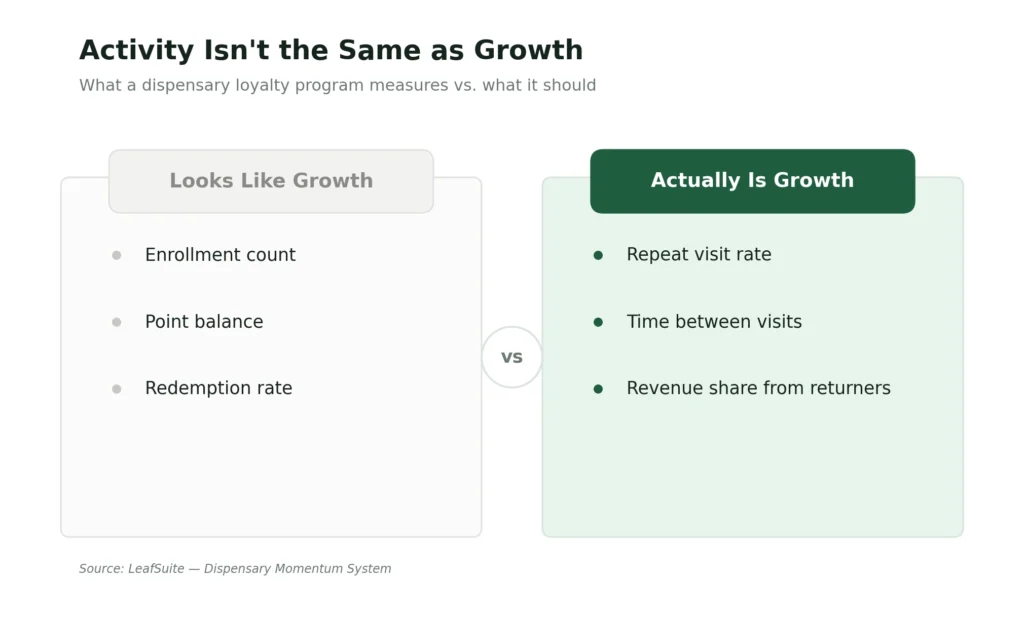
A loyalty program is valuable when it measurably shortens the gap between visits and grows the share of revenue coming from returning customers. Enrollment counts, point balances, and redemption rates describe activity, not value. If the program is not changing how often people come back, it is a discount scheme with a database attached.
This is also why loyalty is the cheapest growth available to most dispensaries. Local search, listings, and reputation work bring someone through the door once. Getting that person back a fourth and fifth time costs a fraction of getting a new person in for the first — and the list is already yours.
How to judge the loyalty platform you already have
Most dispensaries do not need a new platform. They need the one they are paying for to be operated. Before anyone proposes a migration, the platform should fail on something specific:
- Can you segment by recency and frequency and act on those segments without exporting to a spreadsheet?
- Can you automate the sequences that run themselves — welcome, birthday, winback — rather than sending everything by hand?
- Does it hold consent state cleanly, so opt-ins and opt-outs are reliable across both email and SMS?
- Can you attribute revenue to a campaign, and see the attribution logic rather than a single unexplained number?
- Can you export your own list, in full, whenever you want?
Those five questions are the criteria. Springbig and Alpine IQ both answer most of them, which is why the platform decision matters far less than the operating rhythm behind it. LeafSuite is a Springbig Certified Marketing Partner, and the Retention Engine is built to run on whichever loyalty platform a dispensary already uses. We do not make switching a precondition — a migration costs weeks of momentum and rarely fixes the actual problem.
The last question on that list is the one worth being uncompromising about. A subscriber list you cannot export is not your list. Consent, contact records, and purchase history should live somewhere you own, which is what the Digital Dispensary Foundation is for. Platform contracts end. The list should not end with them.
Where loyalty connects to the rest of the system
Loyalty does not work in isolation, and treating it as a standalone tactic is why so many programs stall. Local Demand Capture makes the dispensary the obvious choice for someone searching nearby. The Retention Engine captures those first-time buyers into a list the Digital Dispensary Foundation owns, then works that list week after week. Loyalty is the mechanism that connects the three — the points are how the customer volunteers their contact information, and the sequences are what turn it into revenue.
The channels that carry it are email and SMS. Cannabis email marketing does the long-form work — education, new drops, brand. Dispensary text marketing does the urgent work, and it is the channel most dispensaries under-operate relative to what it returns. Both depend on permission that holds up, so build the list on real opt-in and keep the consent record clean — the FTC’s CAN-SPAM guidance is the baseline on the email side, and carrier rules on the SMS side are stricter than most operators expect.
None of that requires a new platform. It requires someone doing it on a schedule. Search is what anchors the top of the funnel, and how search fits the rest of a dispensary’s marketing is worth reading alongside this if the loyalty list is small because foot traffic is small.
The compounding part
A loyalty program run once a quarter produces nothing that compounds. Run weekly, the same list gets better at predicting itself: the segments sharpen, the sequences get tuned against real numbers, and the share of revenue from returning customers climbs quarter over quarter. That is the whole return on retention work — not one campaign, but a list that is worth more in month twelve than it was in month one.
Related: Vallejo Relief Center had a loyalty platform sitting dormant. Once the Retention Engine was operating it week after week, the program produced $11K+/month in Springbig-attributed revenue and grew to 4,000+ opted-in subscribers — 2.3× list growth in two years. The platform did not change. The operating rhythm did. Read the VRC case study.
Points Are Accruing. Is Anyone Actually Coming Back More?
A free audit shows what your loyalty program is really doing — beyond the redemption rate.