Your customer opens a text within minutes. That same message sent as an email might sit unread until tonight — if it gets opened at all. Nothing about the message changes; only the channel decides whether it gets read.
That gap is why cannabis email marketing and dispensary text marketing aren’t competing tactics — they’re the same retention engine running at two different speeds. Email carries the story. Text carries the moment: the restock that just landed, the drop that closes tonight, the loyalty points about to expire. A dispensary running only the slow channel is leaving the fast one on the table.
Why Does Text Marketing Outperform Email for Dispensaries?
Text gets opened within minutes because it interrupts, while email waits to be checked. For a dispensary, that speed advantage matters most for anything time-sensitive — a same-day restock, flash pricing that closes tonight, a loyalty tier about to expire — moments email is simply too slow to catch.
Weedmaps placement and paid menus get a dispensary found once, and you’re renting that visibility for as long as you keep paying. A text list works differently: it’s a number a customer typed in themselves, which means nobody can outbid you for a spot in it and nobody can take it away when a platform changes its terms.
See how LeafSuite builds this into a weekly system for licensed dispensaries. → Retention Engine
Is Text Marketing Legal for Cannabis Dispensaries?
Yes, as long as every subscriber opted in affirmatively, every message includes a working opt-out, sends land inside reasonable hours, and the content follows the same cannabis advertising rules as every other channel. Speed doesn’t excuse skipping compliance — it’s exactly why dispensaries get in trouble here faster than anywhere else.
A few non-negotiables sit on top of whatever your state’s cannabis ad rules layer in. Every subscriber has to opt in through a checkout prompt or a keyword-to-join — never a number pulled from a POS system without separate consent. STOP has to actually work. Sending windows need to stay inside reasonable hours; a 7am promo text is the fastest way to earn a block. And the message itself still has to clear the same age-gating and no-product-imagery restrictions that govern every other channel a dispensary uses.
This is also why so few dispensaries run text well: general-purpose SMS platforms won’t touch cannabis, and cannabis-aware platforms like Springbig and Alpine IQ exist specifically to keep a list compliant while it scales. The tools matter as much as the strategy.
What Does Real Campaign Data Show About Getting Dispensary Text Marketing Right?
Segmentation is the single biggest lever, deal-forward messages consistently beat brand or content-style texts, and delivery stays remarkably reliable when the list is opted-in and compliant. We see all three patterns repeat month after month across LeafSuite’s Retention Engine clients.
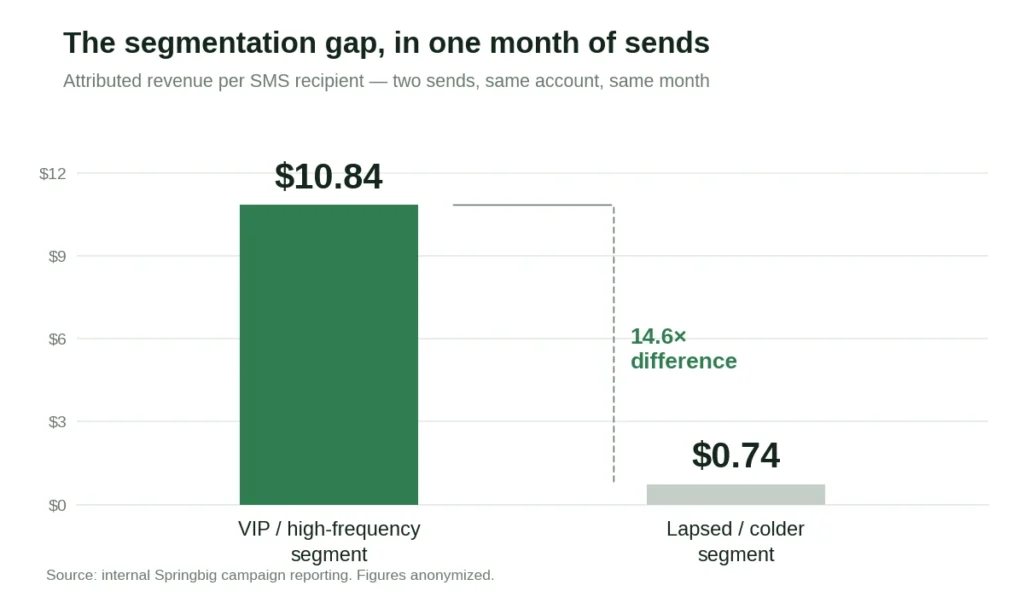
The segmentation gap is the starkest number in the data. In one recent month, a tightly targeted SMS sent only to VIP and high-frequency customers returned $10.84 in attributed revenue per recipient. A broader send to a colder, lapsed segment — same client, same month — returned $0.74 per recipient. That’s a 14.6× difference, and it isn’t a one-off: the same split between “narrow and warm” versus “broad and cold” shows up again and again across different clients and different months. A smaller, sharper list beats a bigger, softer one almost every time.
The second pattern is about message content, not audience: concrete, deal-forward SMS — a specific discount, a specific product, a specific deadline — outperforms brand-building or content-style texts on a consistent basis. One client’s campaign data showed this same signal for two consecutive months running. Save the storytelling for email; make text about the offer.
The third pattern answers the question every operator asks before they start: will this annoy people? Across recent months of real client sends, delivery rates land in the 98–100% range and opt-outs stay near zero. A compliant, opted-in list doesn’t generate the backlash dispensaries worry about — it generates a channel people stay on. And the automations sitting on top of that list — welcome flows, birthday texts, win-backs — keep compounding without new work: one client’s automation revenue alone roughly doubled month over month purely from list growth, with no new campaign written.
What Does a Dispensary Text List Actually Do, Once It’s Running?
Put those patterns to work and a text list turns retention into same-day action: a regular who’s drifting gets a nudge today instead of at the next newsletter, a restock reaches the customers who will actually buy that strain the moment it hits the shelf, and a loyalty tier about to expire gets one text instead of getting missed in an inbox.
None of that works as a standalone blast calendar, and it doesn’t work as the only channel doing the talking. Text is the fast layer sitting on top of the same infrastructure that makes email marketing work: a list a dispensary owns outright rather than rents from a platform — which is exactly what the Digital Dispensary Foundation is built to secure — fed by Local Demand Capture bringing new customers in the door, and put to work by the Retention Engine that decides who gets a text, who gets an email, and who gets both.
Why Does This Matter for Dispensaries Right Now?
A points system only moves a customer if they hear about it fast enough to act, and text is the only channel built for that speed. New York legalized dispensary loyalty programs for the first time in December 2025, in the same rule change that closed off a paid advertising channel operators had leaned on for years.
That’s not just a New York story, it’s the shape regulation keeps taking across cannabis markets, and we broke down what New York’s specific changes mean for operators here. Every dispensary in a market like that is building loyalty infrastructure from zero, on the same day, for the first time. The ones setting up text alongside the new program now are the ones who won’t be re-explaining “we have a rewards program” a year from now to customers who never heard about it the first time.
The Bottom Line
Email is the channel your dispensary already owns. Text is the one that gets read today instead of tonight. Run them as one system — not two separate calendars competing for the same customer’s attention — and the list stops being a marketing cost and starts being the fastest lever you have.
At Vallejo Relief Center, the Retention Engine runs weekly segmented Email + SMS to 6,000+ customers — driving $11K+ per month in Springbig-attributed revenue (~5.2× ROI) off a list that’s grown 2.3× in two years, with a 29% higher opt-in rate.
What’s Your List Worth Per Text?
A growth audit shows whether your list is built for SMS, which segments are worth texting, and what you’re leaving on the table without it.