A lot of dispensaries don’t have a website strategy. They have a Dutchie or Jane storefront embedded on a template page, a Weedmaps or Leafly listing they pay for every month, and nothing that actually belongs to them in between.
That gap is expensive in a way that doesn’t show up on an invoice. Every one of those platforms is renting you shelf space. The moment you stop paying, or the moment their algorithm decides another dispensary deserves the placement instead, the visibility goes with it — and you’re left with no rankings, no subscriber list, and no site of your own to redirect that traffic to. Real dispensary website development means building the one asset in your stack that nobody else can switch off: a site you own, that Google can index, and that turns every visitor into data you keep.
POS menus and marketplace listings solve different problems than a website does
It helps to separate what Dutchie, Jane, and Treez actually do from what Weedmaps and Leafly do, because dispensaries tend to lump them together and then blame the wrong one when growth stalls.
Dutchie, Jane, and Treez are transaction layers. They hold your live inventory, run your cart, and process the order. That’s real infrastructure, and a good dispensary site should integrate with one of them cleanly — that’s the menu-and-speed layer we cover in what cannabis website design actually needs. But a menu widget doesn’t have a title tag, doesn’t build local landing pages, and doesn’t know what a customer searched before they arrived. It’s built to check people out — not to get found or remembered.
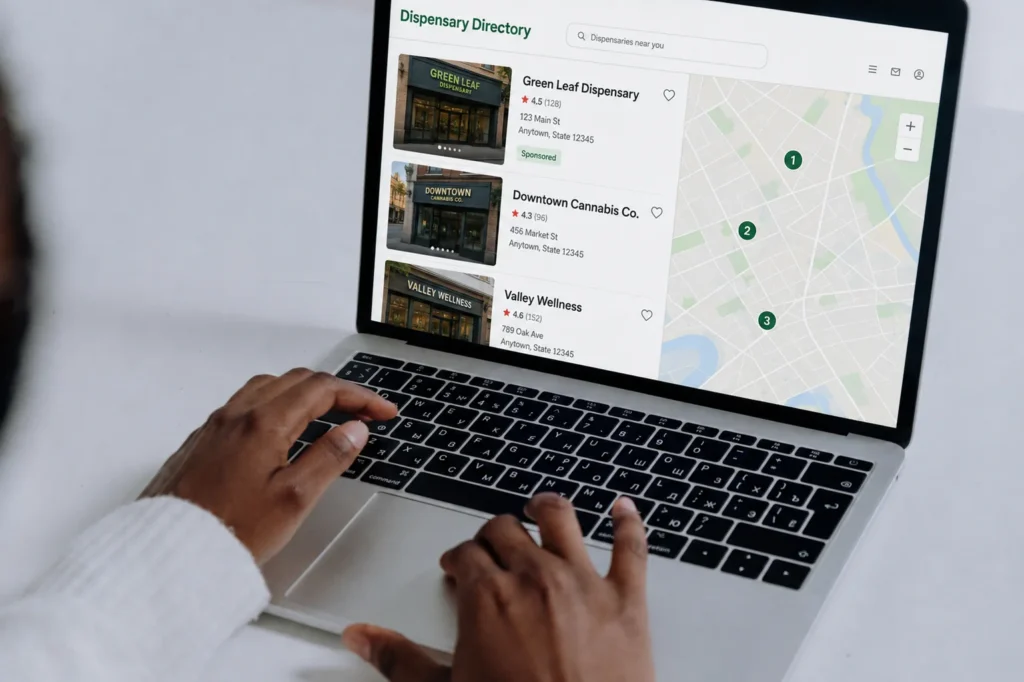
Weedmaps and Leafly are a different category entirely: marketplace listings you’re renting alongside every competing dispensary in your radius. You’re paying to be discoverable inside somebody else’s directory, on a page they control, next to a “sponsored” competitor one scroll away. There’s nothing wrong with using one — most operators should — but it’s a distribution channel, not a home base. Nothing you build there compounds, because none of it is yours.
What dispensary website development actually has to deliver
A site that earns its keep does four things none of the platforms above can do for you:
- Owns the SEO surface. Location and category pages, structured so Google can index them, ranking for the searches happening in your market — not just inside a marketplace’s internal search bar.
- Captures first-party data. Every opt-in, loyalty signup, and promo claim happens on infrastructure you control, feeding a subscriber list that’s yours whether or not you keep advertising anywhere else.
- Converts the traffic the other channels send you. Rankings and reviews built by Local Demand Capture mean nothing if the visitor lands on stale hours or a menu that takes four taps to reach a cart.
- Still connects to the platforms that matter. The menu integration lives here too — Dutchie, Jane, Treez, whichever you run — just as one piece of the site, not the whole thing.
See how LeafSuite builds this into a weekly system for licensed dispensaries. → Digital Dispensary Foundation
The three costs of treating a platform as your website
You don’t own the ranking. Search visibility built entirely inside Weedmaps or Leafly belongs to that platform’s domain, not yours. Every bit of authority you help build there compounds for them — it doesn’t transfer if you leave, and it doesn’t show up when someone searches Google directly for your dispensary.
Growth resets to zero the day you stop paying. A marketplace listing’s visibility is rented, not earned. An owned site keeps its rankings, its content, and its subscriber list running whether or not this month’s ad budget clears.
You can’t market to anyone who didn’t buy today. A POS storefront captures a transaction, not a relationship. Without a site collecting opt-ins on your own terms, there’s no list to send a win-back text to next month — the Retention Engine has nothing to work with, because nothing was captured to retain.
Where these platforms genuinely belong
None of this is an argument against Dutchie, Jane, Treez, Weedmaps, or Leafly — LeafSuite integrates with the first three directly, and most dispensaries should keep a presence on the marketplaces too. The point is sequencing: they’re inputs to a website development strategy, not a substitute for one. The menu platform handles inventory. The marketplace listing handles discovery you don’t control. The site is what turns both into rankings you keep, data you own, and customers who come back without you paying a platform for the introduction twice.
Related proof: One dispensary we work with came in on a slow, menu-dependent site with online ordering buried three taps deep. After the Digital Dispensary Foundation build, their Google PageSpeed score moved from 55 to 92 — the site stopped being the reason customers dropped off.
Is That Really a Website — Or Just Rented Shelf Space?
Most dispensaries can’t tell the difference until the bill stops getting paid. See where you stand.